For years, healthcare has responded to staffing shortages the same way.
Hire more people.
Increase overtime.
Build larger float pools.
Bring in travelers when the schedule starts to break down.
Those strategies have helped organizations navigate workforce shortages, but they're becoming increasingly difficult to sustain. The challenge isn't simply finding qualified imaging professionals. It's finding them quickly enough to keep pace with unpredictable demand while protecting the teams already in place.
According to the American Society of Radiologic Technologists' 2025 Radiologic Sciences Workplace and Staffing Survey, vacancy rates across major imaging disciplines remain near historic highs. Even specialties that have improved continue to face significant workforce challenges compared to where they were just a few years ago.
Those numbers aren't just recruiting statistics. They show up every day inside imaging departments.
Open positions stay open longer.
Existing staff cover additional call.
Managers spend more time solving scheduling problems than improving department performance.
Coverage has become a daily operational challenge.
And that's exactly why the conversation needs to change.
Coverage Has Become an Operational Challenge
Imaging departments rarely operate on a predictable schedule.
Patient volumes fluctuate. Emergency departments experience unexpected surges. A single callout on a fully booked day can affect patient throughput for hours.
Yet many organizations are still managing those situations with the same manual process they've relied on for years.
Someone starts making phone calls.
Managers begin rearranging schedules.
Technologists volunteer to stay late or give up another day off.
Eventually, coverage is found.
Then the process repeats itself the next day.
Healthcare has become far more dynamic than the staffing models supporting it. That's why Roshal Health believes coverage should be managed differently.
Rather than treating every uncovered shift like an isolated staffing event, Roshal approaches diagnostic coverage as an operational function supported by technology. The goal isn't simply filling open shifts. It's giving healthcare organizations reliable access to qualified imaging professionals exactly when they're needed.
Modern Coverage Requires Modern Infrastructure
Think about how much visibility we expect from technology today.
We can watch a package move across the country.
Track a rideshare down to the minute.
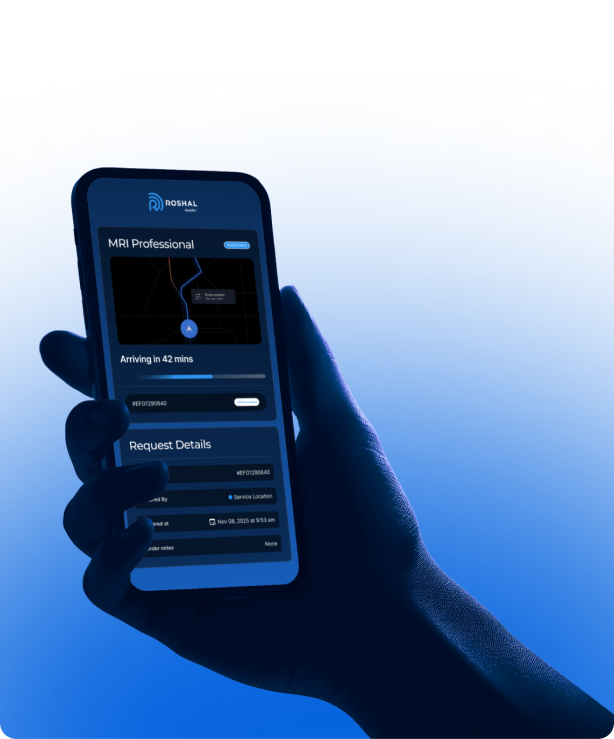
Know exactly when a service technician will arrive.
Healthcare operations deserve that same level of confidence.
Coverage shouldn't depend on voicemail, spreadsheets, or hoping someone answers the phone.
It should provide real-time visibility into what's happening, who's responding, and when support will arrive.
That kind of transparency doesn't just improve communication.
It changes how imaging departments operate.
Instead of reacting to uncertainty, leaders can make informed decisions with confidence.
Technology Should Remove Friction, Not Replace People
One of the biggest misconceptions about technology in healthcare is that it's designed to replace people.
The opposite is true.
The best technology removes administrative work so healthcare professionals can spend more time focused on patient care.
That includes the work happening behind the scenes every time coverage is requested.
- Credential verification
- Compliance documentation
- Intelligent matching
- Dispatch coordination
- GPS arrival updates
- Secure communication
Every one of those tasks is essential.
None of them should require hours of manual coordination every time an imaging department needs help.
Built Around Technology, Not Added Later
Roshal Health wasn't built as a staffing agency that later added technology.
Technology is the foundation of the entire platform.
When a hospital or health system requests coverage, Roshal intelligently matches certified imaging professionals based on credentials, availability, location, modality, and operational requirements.
Facilities know when coverage has been accepted.
They know who's responding.
They know when the technologist is expected to arrive.
For imaging professionals, everything happens through the Roshal app. New assignments, communication, navigation, and workflow all happen within a single connected platform.
With Apple CarPlay and Android Auto integration, technologists can safely access navigation and assignment information while traveling between healthcare facilities, helping reduce distractions and making transitions more efficient.
The result is a connected experience for both healthcare organizations and imaging professionals.
Confidence Is the Real Product
Healthcare leaders aren't looking for another software platform.
They're looking for confidence.
Confidence that coverage requests won't disappear into voicemail.
Confidence that credentialing has already been verified.
Confidence that qualified imaging professionals are already on the way.
Confidence that patients won't experience unnecessary delays because a department couldn't secure coverage quickly enough.
That's what technology should deliver.
Not more complexity.
More certainty.
The Future of Diagnostic Coverage
Healthcare doesn't need another staffing company.
It needs better operational infrastructure.
The organizations leading diagnostic imaging over the next decade won't simply have larger staffing budgets.
They'll have smarter systems that connect qualified imaging professionals with healthcare facilities quickly, securely, and predictably.
That's the difference between reacting to staffing shortages and building true coverage resilience.
Roshal Health's tech-enabled talent-sharing platform helps hospitals and health systems move beyond traditional staffing models by providing on-demand access to licensed, credentialed imaging professionals across multiple modalities.
Because the future of diagnostic coverage isn't about owning more labor capacity.
It's about having immediate access to it whenever your patients need it.
Get access to Roshal's network of medical professionals today.