“What if where you live no longer determined the level of care you receive?”
It is a simple question. But in rural healthcare, it is a profound one.
Across the country, critical access hospitals serve as the backbone of their communities. They are the first stop for chest pain, trauma, abdominal emergencies, and prenatal care. Yet many of these facilities face a quiet but urgent challenge.
They cannot consistently provide diagnostic imaging.
Not because they lack equipment.
Not because they lack patients.
But because they lack certified sonographers.
So, the real conversation begins there.
The Problem Is Not the Machine
Imagine a rural hospital administrator reviewing next year’s budget.
The ultrasound machine is in place. The exam rooms are ready. Physicians are asking for cardiac and vascular imaging support.
But there are not enough sonographers to cover all of the facility's needs.
Recruiting more means competing with large metropolitan systems offering higher salaries and lifestyle advantages. Paying travel rates can double or triple labor costs. And even if someone is hired, retention is uncertain.
So, what happens?
Patients are transferred.
An ambulance leaves town for a two-hour transport to an urban hospital for a scan that should have been performed locally. The ambulance is unavailable for other emergencies. The rural hospital loses revenue. The patient and family bear the burden of distance.
Multiply that scenario across dozens of communities, and the strain becomes systemic.
The question becomes unavoidable.
Is there a better way?
Rethinking the Model
What if the hospital did not need a full-time sonographer onsite?
What if the expertise could be shared?
What if the hands performing the scan and the brain directing the scan did not have to be the same person in the same room?
This is where Roshal Health’s remote imaging model changes the equation.
How Remote Imaging Works in Practice
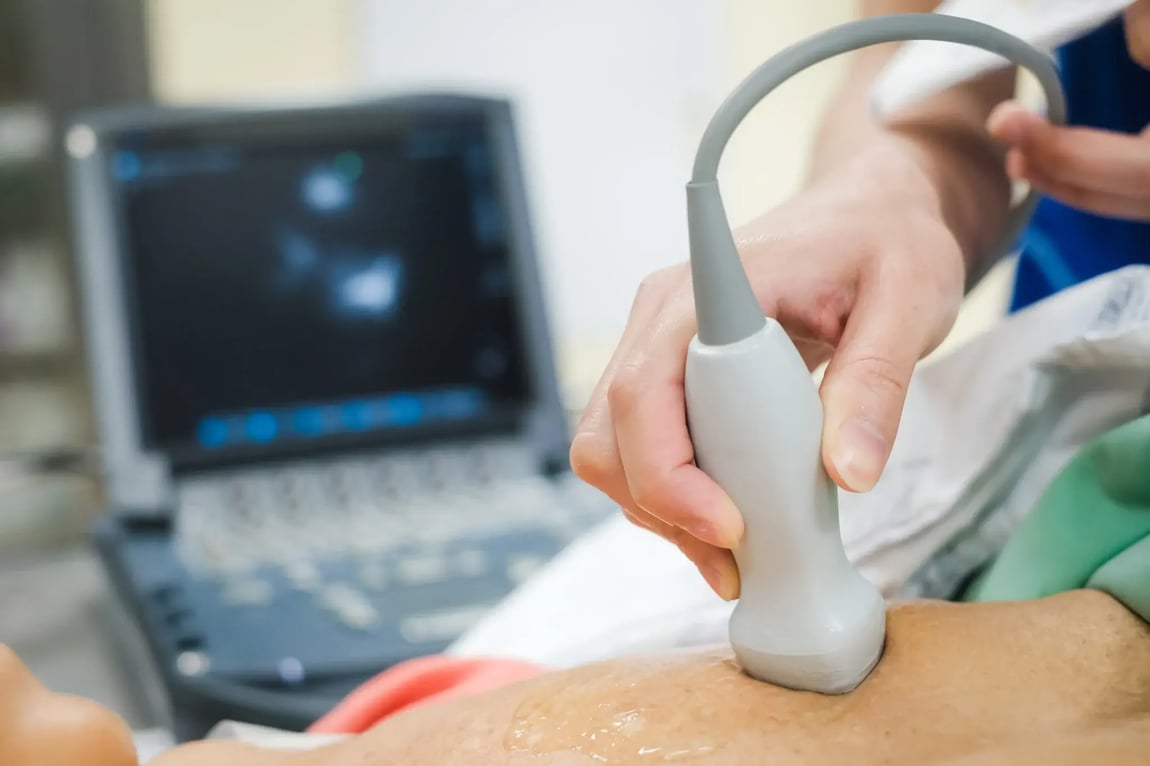
In a Roshal Health supported model, the bedside remains local.
A nurse or tech positions the probe and supports the patient. They are part of the community. They know the facility. They are already trusted members of the care team.
Connected through secure real time tele-ultrasound technology, a certified sonographer guides the exam live.
They see the imaging feed instantly.
They direct probe positioning.
They confirm image quality.
They ensure diagnostic standards are met before the patient leaves the room.
This is not delayed review. It is real time clinical collaboration.
The expertise is present. It is simply delivered differently.
The Impact on Rural Hospitals
This shift does more than solve a staffing problem. It transforms operational capacity.
Instead of struggling to recruit one full time specialist to a single location, Roshal Health enables expert sonographers to support multiple facilities efficiently. Travel time disappears. Expertise becomes scalable.
For rural hospitals, that means:
-
Expanded access to cardiac and general ultrasound services
-
Reduced reliance on costly travel staffing
-
Reduced patient leakage
-
Preserved imaging revenue
-
Stronger financial stability
It also strengthens internal teams. Local staff gain advanced capabilities through guided collaboration with Roshal Health, increasing engagement and retention.
The hospital remains independent, but no longer isolated.
A Different Kind of Sustainability
Rural healthcare conversations often focus on closures. On shrinking services. On survival.
Remote imaging reframes the narrative.
Instead of asking how to maintain the bare minimum, hospitals can ask how to expand access responsibly.
When imaging stays local, patients stay local.
When patients stay local, revenue stays local.
When revenue stays local, hospitals remain viable.
Roshal Health’s technology enabled talent-sharing platform was built for this exact challenge. By combining credentialed imaging professionals with responsive deployment and secure connectivity, the company helps facilities close critical gaps without adding unsustainable overhead.
The goal is not to replace rural hospitals.
It is to reinforce them.
Beyond Geography
At its core, this is a conversation about removing barriers.
For decades, geography dictated access. Urban patients had specialists nearby. Rural patients traveled.
Remote imaging changes that equation.
When expertise can be delivered in real time across distance, location becomes less of a limitation. Critical access hospitals become connected endpoints within a broader diagnostic network.
And patients receive timely, high quality imaging without leaving their communities.
The future of rural healthcare will not be defined by how far a patient must travel.
It will be defined by how effectively expertise can travel to them.
Roshal Health is committed to making that future a reality, contact us today!